
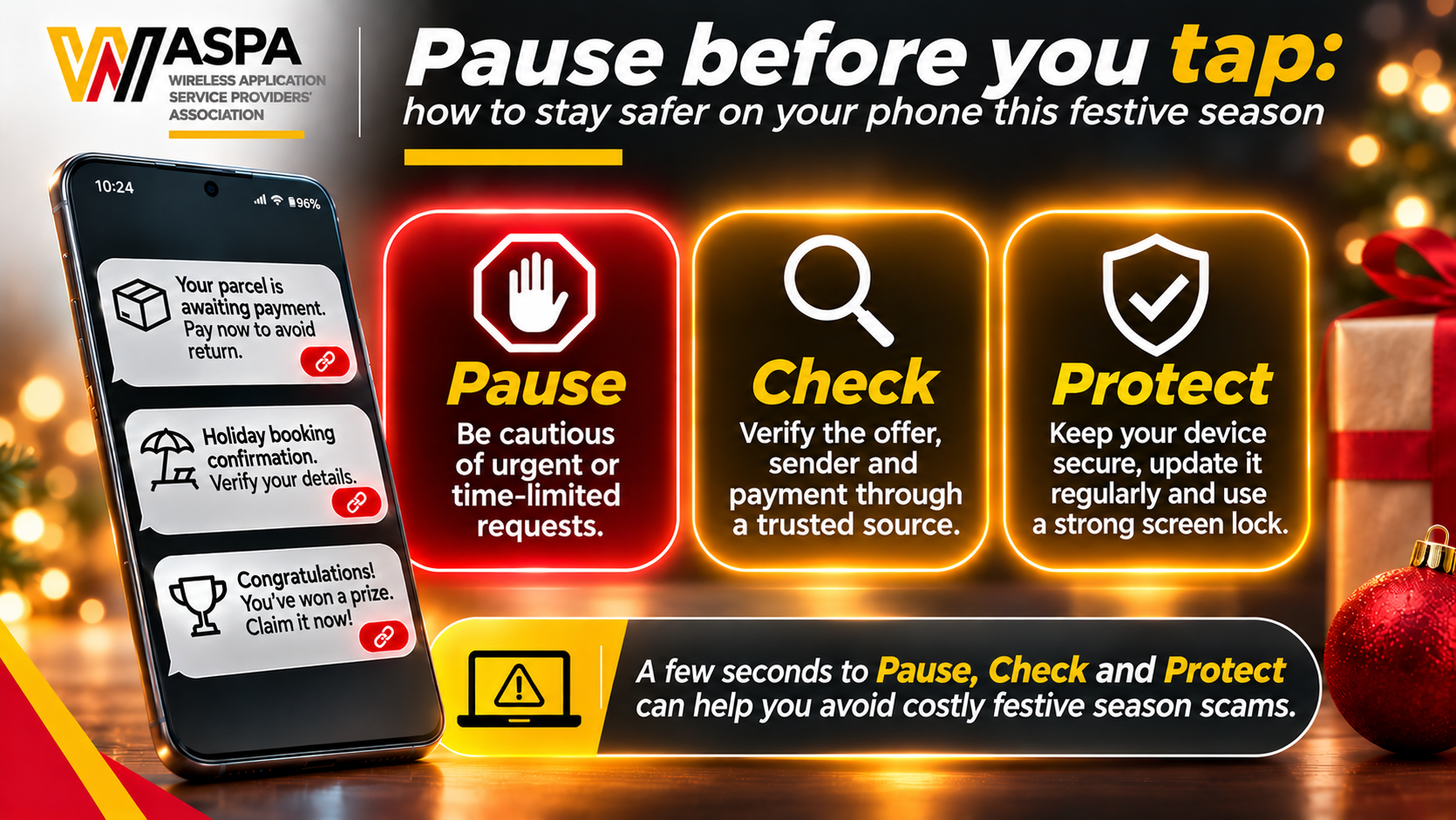
An urgent delivery notice, a discounted holiday booking or a surprise competition win can arrive at exactly the moment consumers are at their busiest. WASPA says three simple habits can help people make safer decisions before money or personal information changes hands.
The festive season has always been busy. What has changed is how much of that activity now happens through a mobile phone. Consumers shop, receive parcel updates, make travel arrangements, pay deposits, enter competitions and manage banking from the same device. That convenience also gives criminals more opportunities to imitate familiar brands and place false requests directly in a consumer’s hand.
A fraudulent message does not need to be perfect. It only needs to arrive when someone is distracted, expecting a delivery or worried that a booking may be cancelled. Messages may claim that a parcel is awaiting a small customs payment, that a bank account requires urgent verification, or that a consumer has won a prize that must be claimed immediately. The apparent fee can be small, but the link may be designed to collect card details or login credentials.
“The most effective scam messages often borrow the circumstances of ordinary life. A consumer may really be waiting for a parcel or planning a holiday, which makes the false message feel believable. Our advice is simple: pause before you react, check the claim through a channel you trust, and protect the credentials that protect your accounts, says Noelan Rungasamy, General Manager of WASPA.”
Pause: urgency is a warning, not an instruction
Consumers should be particularly cautious when a message creates a deadline that leaves little time to think. Threats that an account will be closed, a parcel returned or a prize forfeited are intended to move the recipient from consideration to reaction. The safest first step is to stop and ask whether the message was expected.
Poor spelling can be a clue, but well-written messages can also be fraudulent. A logo, a professional design or a local-looking telephone number is not proof that the sender is genuine. Caller identification and message display names can be misleading, while a web address may differ from the genuine address by only one letter.
Instead of using the link or number in the message, consumers should open the organisation’s official app, type a known website address themselves or use a telephone number printed on a bank card, statement or confirmed booking. This separate-route check is one of the most useful habits a consumer can develop.
Check: the offer, sender and payment destination
Before paying for travel, accommodation or a festive promotion, check whether the offer appears on the provider’s official website and whether the account details match information obtained independently. A sudden change in banking details should always be verified through a separate channel, particularly when a deposit is involved.
Competition messages deserve the same scrutiny. Consumers should be able to identify the promoter, find the competition terms, understand any entry cost and confirm how winners are selected and contacted. A demand for a “release fee”, “insurance payment” or “administration charge” before a prize is delivered is a major warning sign.
Checking also means considering what the sender is asking for. A legitimate support agent or promoter should not need a banking password, card PIN or one-time PIN. A verification code is often the final key needed to approve a login or transaction. Sharing it can give another person control over an account.
Protect: secure the device as well as the transaction
Basic device security matters because a phone is often the key to email, banking, social media and cloud storage. Consumers should use a strong screen lock, install trusted software updates, review app permissions and remove applications they no longer use. Device-finding and remote-lock features should be enabled where available.
Public Wi-Fi can be convenient while travelling, but consumers should be cautious about sensitive transactions on unknown networks. When a transaction cannot wait, a trusted mobile connection or a network that can be verified is preferable. Important booking references should be backed up securely, without leaving unprotected copies of identity documents in an easily accessible folder.
Families should also discuss these risks before travelling. Children may encounter attractive downloads, game purchases or competition links without recognising the value of the information being requested. Purchase controls, age-appropriate conversations and clear family rules are more effective than relying on a warning after something has gone wrong.
If you have already responded
A consumer who has entered card details, supplied credentials or approved a transaction should contact the relevant bank or service provider immediately. Passwords should be changed through the official service, and any available account-security or device-locking feature should be used. Screenshots, sender details, dates, times and proof of payment should be preserved.
WASPA can assist with relevant reports of SMS spam, unwanted WASP billing and complaints involving possible breaches of its Code by members. However, not every scammer or sender falls within WASPA’s jurisdiction, and suspected fraud may require assistance from a bank, service provider, law-enforcement body or another regulator.
“Consumer safety does not depend on recognising every scam format. It depends on slowing the interaction down and refusing to hand over money, access or personal information until the request has been independently verified, Rungasamy says.”
About WASPA
WASPA is a South African membership-based industry body that performs a self-regulatory role over its members. Its Code of Conduct binds members, while its consumer channels provide routes for reporting relevant SMS spam, unwanted WASP billing and possible Code breaches. WASPA can act within its jurisdiction over members, but it is not a bank, law-enforcement agency or regulator of mobile network operators.